Smartphone Parts
Learn to recognize important parts found inside smartphones and understand their role in the overall device.
Nowadays Smart Phones Components is a practical technical book designed to help smartphone repair technicians understand the parts inside modern smartphones, what those parts do, how their values and characteristics can be understood, how damaged components can be recognized and how repair decisions can be approached.
Understanding smartphone components is one of the foundations of professional mobile phone repair. Before a technician can diagnose a fault, the technician needs to recognize the relevant part, understand its function and know what symptoms may appear when that part is damaged.
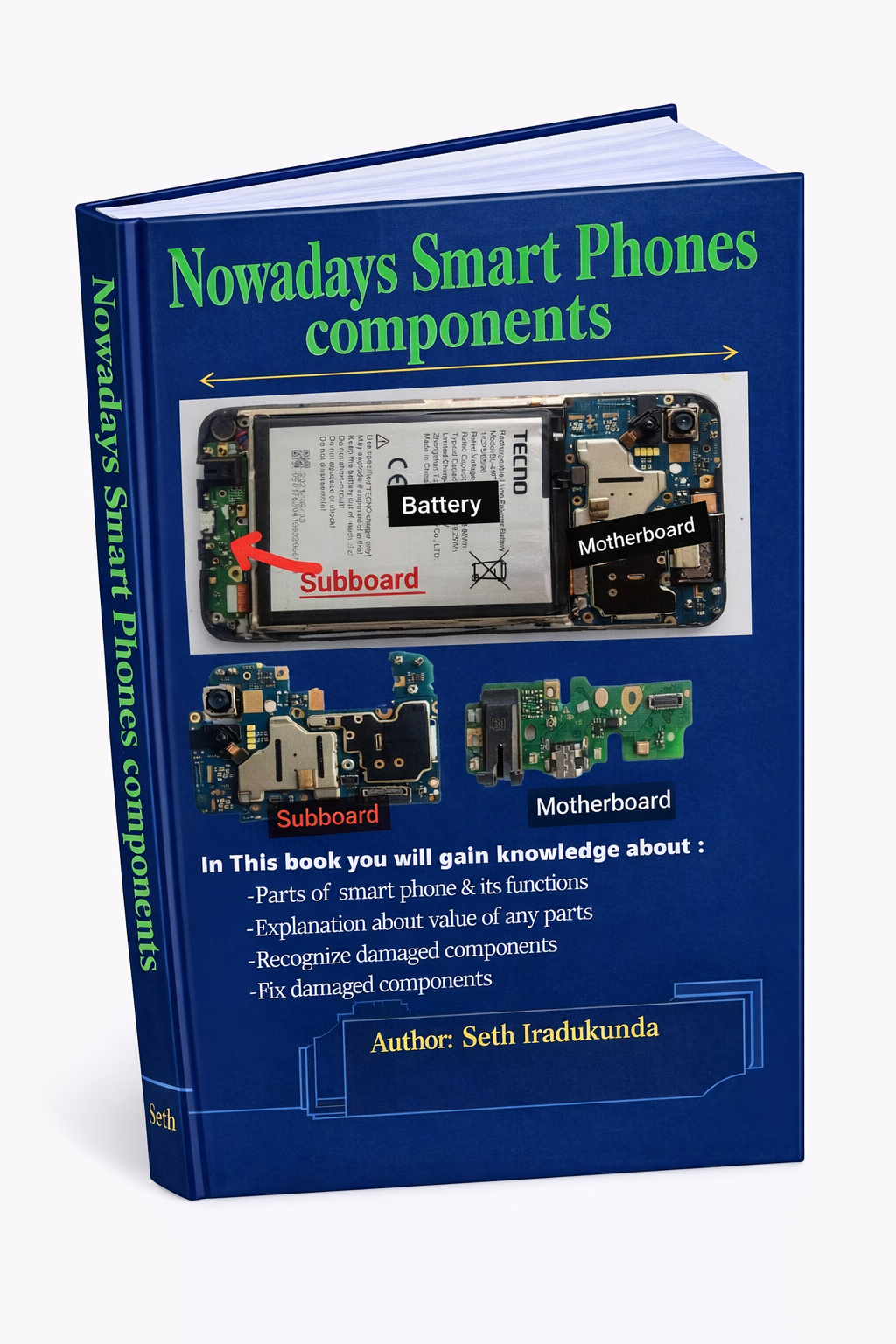
A practical foundation for smartphone repair technicians and electronics learners.
Nowadays Smart Phones Components is an educational book created for people who want to understand the components found inside modern smartphones. Smartphone repair is not only about replacing screens, batteries or charging ports. A technician also needs to understand what is inside the device and what each part is responsible for.
Modern smartphones contain many electronic and mechanical parts. These parts work together to provide functions such as charging, power management, communication, audio, cameras, display, touch input, wireless connectivity, processing, storage and sensing.
When a smartphone develops a problem, understanding the components can help a technician narrow down possible causes. A phone that does not charge, for example, may require a different diagnostic approach from a phone with an audio problem, display problem, microphone problem or network problem.
In this book you will gain knowledge about:
Parts of smart phone and their functions — learn to identify important smartphone parts and understand the purpose each part serves inside the device.
Explanation about the value of any part — develop an understanding of component values and characteristics that can be relevant when identifying and troubleshooting electronic parts.
Recognize damaged components — learn about characteristics and symptoms that may indicate that a component is damaged or not operating as expected.
Fix damaged components — develop a better foundation for approaching smartphone component repair and troubleshooting.
The book focuses on understanding the relationship between smartphone parts, their functions and common fault conditions.
Learn to recognize important parts found inside smartphones and understand their role in the overall device.
Understand what different components do and how their functions contribute to smartphone operation.
Learn why component values and characteristics matter when diagnosing electronic circuits.
Develop knowledge about characteristics that can help identify damaged or defective components.
Build a foundation for understanding how technicians approach damaged components during smartphone repair.
Learn to connect symptoms, components and possible causes when investigating smartphone problems.
Smartphones contain many interconnected parts. Understanding their roles gives technicians a stronger foundation for diagnosis.
Supplies electrical energy to the device.
Responsible for managing charging-related electrical functions.
Captures sound for calls, recordings and other audio functions.
Produces audio for calls, media and alerts.
Provides image and video capture functions.
Provides visual information to the user.
Detects user touch and interaction with the screen.
Support communication between the phone and external networks or devices.
Performs processing operations required by the smartphone.
Stores data and supports device operation.
Help the smartphone detect different physical conditions and movement.
Provide electrical and physical connections between parts.
It is important that you understand the components of smartphones and their uses, as well as know the characteristics of the dead or damaged components, because that knowledge is what can help you understand exactly what problem the smartphone has and how to approach solving it.
Smartphone repair requires more than knowing how to replace visible spare parts. A technician may encounter a device that looks physically normal but has an electrical or electronic fault inside the motherboard. In such situations, component knowledge becomes extremely important.
When a technician understands the function of a part, it becomes easier to connect a device symptom with possible causes. For example, a problem involving audio may require investigation of audio-related components, connections and circuits rather than immediately replacing unrelated parts.
This knowledge can also help technicians communicate more clearly when discussing repairs, identifying components and explaining why a particular part may need attention.
All smartphones contain many of the same broad categories of parts, even though the components may not look the same on the inside. Different manufacturers use different designs, layouts, components and technologies.
Smartphones also contain more parts and spare parts than many older regular phones. As smartphone technology has developed, manufacturers have added more features, sensors, cameras, communication systems, processing capabilities and power-management functions.
Because of these differences, technicians should not assume that a component from one smartphone model can automatically be used in another model. Compatibility can depend on the manufacturer, model, circuit design, component specifications and physical construction.
Depending on the manufacturer and model, the location of a component can change. A technician therefore needs to learn how to identify the component rather than relying only on its physical location from another device.
For example, some smartphone microphones are located on the bottom of the motherboard, while other phones may have the microphone positioned in a different area of the motherboard or connected through a different design.
This difference demonstrates why smartphone repair technicians need broad component knowledge. A repair method that applies to one phone should not automatically be assumed to apply to every other smartphone.
Component knowledge helps technicians approach smartphone repair in an organized way.
Determine the smartphone manufacturer, model and relevant board or component design before beginning detailed troubleshooting.
Determine what the phone is failing to do, such as charging, producing sound, displaying an image or detecting an input.
Connect the observed symptom with components and circuits that may be involved in the affected function.
Use appropriate technical measurements, inspection and repair procedures to investigate the suspected fault.
First, familiarize yourself with the parts of a smartphone. Learning the names and functions of smartphone components is one of the first steps toward becoming a more capable mobile phone repair technician.
A technician should be able to look at a smartphone board or technical illustration and begin identifying important components. This knowledge makes it easier to follow repair information, understand technical diagrams and communicate about specific faults.
The book provides photographs and explanations that help learners connect the names of smartphone parts with their physical appearance. This is useful because components can be very small and can look different from one phone model to another.
The following photos and technical information in the book are intended to help you recognize the names and parts of a smartphone. Understanding these parts gives you a foundation for studying their functions and learning how technicians approach faults.
A strong technician does not begin every repair by replacing parts randomly. Understanding the circuit and identifying the relevant component first can make troubleshooting more logical and efficient.
This book therefore emphasizes knowledge of the smartphone itself. Once you understand what a component does, where it may be found and what can happen when it becomes damaged, you have a stronger foundation for deciding what to investigate next.
The book is designed for people developing practical knowledge about modern smartphone components.
The book is intended to build practical knowledge that can support further smartphone repair study.
Identify common smartphone parts and components.
Understand the functions of smartphone components.
Understand why component values and characteristics matter.
Recognize possible characteristics of damaged components.
Understand the relationship between symptoms and possible components.
Understand why smartphone manufacturers use different component layouts.
Develop a foundation for motherboard troubleshooting.
Build knowledge for further mobile phone repair training.
It is a practical smartphone repair book focused on identifying smartphone parts, understanding their functions, studying component values and recognizing damaged components.
It is useful for smartphone repair technicians, mobile phone repair students, electronics learners, beginners and technicians who want to strengthen their understanding of modern smartphone components.
Component knowledge helps technicians connect smartphone symptoms with possible parts and circuits. It can therefore provide an important foundation for systematic troubleshooting.
Smartphones share many broad component categories, but manufacturers and models can use different designs, layouts, specifications and components. Parts that look similar are not necessarily compatible.
Yes. The physical location of a component can differ between manufacturers and models. For example, microphone placement can vary between different smartphone motherboard designs.
Yes. One of the main areas covered is understanding characteristics that may indicate a component is dead, damaged or not operating normally.
Nowadays Smart Phones Components is intended to give smartphone repair technicians important knowledge about the parts that make modern smartphones work. From basic component identification to understanding functions and possible damage, the book provides a foundation for people interested in mobile phone repair.
The ability to identify a component is only the beginning. A good technician also needs to understand what the component does, what other parts it interacts with and what symptoms may appear when it develops a fault.
Smartphones are constantly evolving. Different manufacturers use different motherboard layouts, components and technologies. This makes general component knowledge especially valuable because it helps technicians adapt their thinking when working on different devices.
Whether you are learning smartphone repair for the first time, already repairing mobile phones or studying electronics, understanding smartphone components can help you develop a stronger technical foundation.
The book focuses on the knowledge technicians need: identifying smartphone parts, understanding their functions, learning about component values, recognizing damaged components and developing a better understanding of how repairs can be approached.
Develop your knowledge of smartphone parts, functions, component values, damaged components and mobile phone troubleshooting with Nowadays Smart Phones Components.
📚 View Books at IGT Tech College